
Fruitbat: Bluey's tiny bedtime story about daring to dream
A two-minute Bluey short that scores a perfect 100 for comfort and 90 for lifting a flat, tired afternoon.
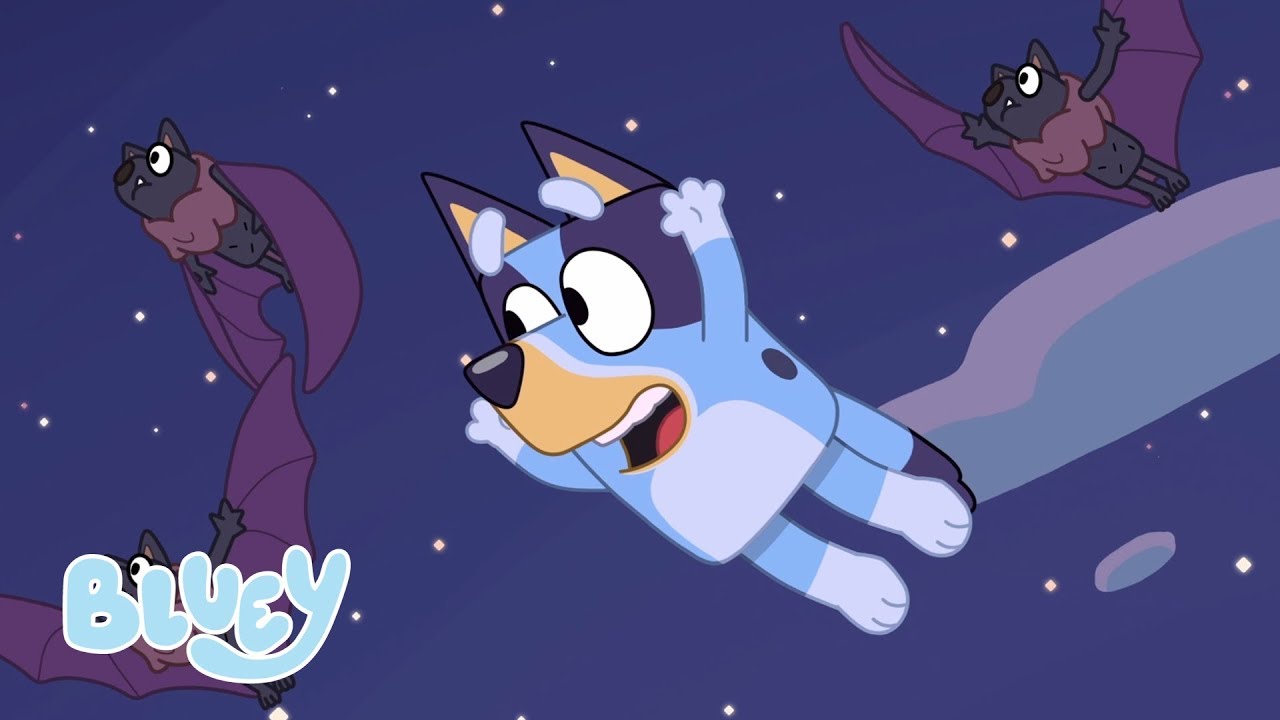

Two minutes of Bluey doing what Bluey does best: a small, ordinary worry (can a fruit bat really fly to the moon?) turned gently into a lesson about self-belief. It scores a perfect 100 for comfort and 90 for lifting a flat, tired mood, with nothing that needs explaining twice. Short enough to slot in anywhere, warm enough to end on.
At a glance
Will it actually calm them down?
 Settles a wound-up mood well
 Its strongest job: lifting a flat, tired afternoon
Scores measure how reliably this video moves a child toward a settled, regulated state. In the Piko app, kids tell us their weather and we do the matching automatically.
The 3:45pm crash this is built for has a name, and knowing it helps: after-school restraint collapse, explained.
Which kids will love it?
Why it works
At 2 minutes 19 seconds with a 5.2-second average shot length and a pacing score of 85, Fruitbat moves at Bluey's usual unhurried clip. There's no direct-to-camera presenter (annoyance score 0), just warm, calm storytelling, and the tone is entirely suggestion-based with no demand language, which is what gives it a healthy rewatch value rated high.
Companion is the strongest play style by a distance, scoring 98 at ages 4 to 5, with Dreamer close behind at 95 and Entertainer at 85 for the same band. That combination, family bonding, gentle imagination, and just enough fun, is the engine here: it's built for watching together and talking about afterwards, not solo background noise.
Regulation-wise it leans further toward lifting than settling: blue-to-green scores 90 against yellow-to-green's 85 and red-to-green's more modest 60, so it's better at brightening a dull afternoon than talking a child down from a full meltdown. It's flagged ASD-safe, PDA-safe, anxiety-safe and ADHD-friendly, with no audio or visual triggers logged, and it's a single story rather than a clip compilation.
When to reach for it
- After-school wobble. Yellow-to-green scores 85, and two minutes is short enough to fit between the school run and dinner.
- Winding down a flat afternoon. Blue-to-green is its strongest score at 90, better suited to lifting tiredness than dramatic meltdown recovery.
- A little chat starter. Companion scores 98 at ages 4 to 5, making it a natural one to watch side by side and talk about after.
Sensory & SEN notes
The engaging-without-frantic balance this video strikes is the one that tends to matter most for ADHD: what actually helps with ADHD and screen time.
If they love this, try these


Questions parents ask
How long is the Bluey Fruitbat episode?
Just 2 minutes 19 seconds. It's one of the shorter entries in Piko's library, scoring a perfect 100 for comfort rating, so it works as a quick, complete watch rather than needing a follow-up episode.
Is Fruitbat calming or more of an energiser?
Piko rates its overall energy effect as neutral, but the numbers lean gentle: blue-to-green scores 90 for lifting a flat mood, yellow-to-green 85 for settling a wound-up one. Entertainer scores 85 too, so there's a little spark of fun alongside the calm.
What age does Fruitbat suit best?
It peaks at ages 4 to 5, where Companion scores 98 and Dreamer 95, and it still holds up well at 6 to 7 (95 and 90 respectively). The themes of dreams and self-belief work across the whole preschool to early-school range.
Is this episode suitable for a child with autism or PDA?
Yes: it's flagged ASD-safe, PDA-safe, anxiety-safe and ADHD-friendly, with a suggestion-based, autonomy-respecting tone and no demand language. No audio or visual triggers are logged against it either.
40+ checks per video, with a final pass from the review desk · Scored 11 July 2026 · We do not host videos; playback is via YouTube's official embed.