
Numberblocks Fast Sums: multiplication made visual for KS1
Ten minutes of maths made visual and playful, scoring a perfect 100 for educational value and an Explorer score of 95 across early years.


Properly educational rather than just badged as such: educational value scores a full 100, with multiplication and arrays taught through visual, physical blocks rather than worksheets. Explorer play style hits 95 at both 4 to 5 and 6 to 7, a rare flat peak that suggests this lands consistently across early years rather than favouring one age. It is instructional by design, rated high on instructional level, so it is a deliberate learning choice rather than a comfort watch, and our data flags it as babyish by 8 plus.
At a glance
Will it actually calm them down?
 Takes the edge off a wound-up mood
 Lifts a flat, tired afternoon
Scores measure how reliably this video moves a child toward a settled, regulated state. In the Piko app, kids tell us their weather and we do the matching automatically.
The zone labels in that chart come from a framework your school may already use: the Zones of Regulation, for parents.
Which kids will love it?
Why it works
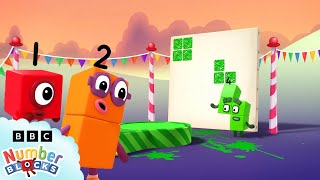
This is CBeebies-style KS1 maths teaching, built around Numberblocks' usual trick of making abstract concepts, here multiplication and arrays, into something visual and countable. It runs at a 5.2 second average shot length with a pacing score of 85, and though there is no on-screen presenter, sensory intensity comes out moderate thanks to high-pitched audio and bright colours doing a lot of the engagement work.
Explorer play style is the standout, 95 at both 4 to 5 and 6 to 7, unusually flat across those two bands, before dropping to 70 by 8 to 9. Entertainer (85) and Companion (80) follow a similar early-years-first pattern. Our data confirms the intended audience directly: it is flagged as babyish for over-8s, with primary-colour aesthetics and an educational tone named as the likely turn-offs at that age.
On regulation, yellow-to-green scores a solid 90, useful for taking the edge off a wound-up child, though the energy effect reads neutral rather than calming, so this is a maths lesson that happens to be soothing in delivery rather than a dedicated wind-down tool.
When to reach for it
- Twenty minutes to cook dinner. Ten minutes long with a comfort rating of 90 and a natural endpoint, useful and quick.
- After school. Yellow-to-green of 90 takes the edge off a wound-up mood while sneaking in some maths.
- Topping up KS1 maths. Educational value scores a full 100, with multiplication and arrays taught visually rather than on a worksheet.
Sensory & SEN notes
If you are weighing this one up for an autistic child, the same checks we ran here are the ones worth running yourself: how to choose videos for autistic children.
If they love this, try these





Questions parents ask
Is Numberblocks Fast Sums actually educational or just badged that way?
Genuinely educational: it scores a full 100 out of 100 for educational value, built around teaching multiplication and arrays through visual, countable blocks rather than abstract sums. Instructional level is rated high, so this is a deliberate KS1 maths learning choice rather than a comfort watch dressed up as one.
What age is this Numberblocks episode best for?
It peaks unusually flat across early years: Explorer play style scores 95 at both 4 to 5 and 6 to 7. It drops off after that, and our data flags it as babyish for over-8s, with primary-colour aesthetics and an educational tone likely to feel young by that age.
Will this help settle a wound-up child?
Reasonably: yellow-to-green scores 90 out of 100, though the energy effect itself is rated neutral rather than calming. Sensory intensity is moderate rather than low, with high-pitched audio and bright colours flagged, so it is engaging rather than a quiet, low-stimulation watch.
Is this safe for a child who is sensitive to sound?
Our data marks it ASD-safe, PDA-safe, anxiety-safe and ADHD-friendly overall, with no demand language despite the high instructional level. It does flag a high-pitched audio trigger and an overall moderate sensory intensity though, worth checking first for a child who is particularly sound-sensitive.
40+ checks per video, with a final pass from the review desk · Scored 11 July 2026 · We do not host videos; playback is via YouTube's official embed.